
AI commercial · Boxing
TALL ORDER: Bringing Real Fighters into a Photoreal AI Colosseum
An open brief became a gladiatorial boxing film—and taught me to generate for the story, not simply for the spectacle.
Spot AI · Pugilato
TALL ORDER: portare veri pugili in un Colosseo fotorealistico creato con l’AI
Un brief aperto è diventato un film di pugilato in chiave gladiatoria e mi ha insegnato a generare per la storia, non semplicemente per lo spettacolo.
“Boxers are the new gladiators.”
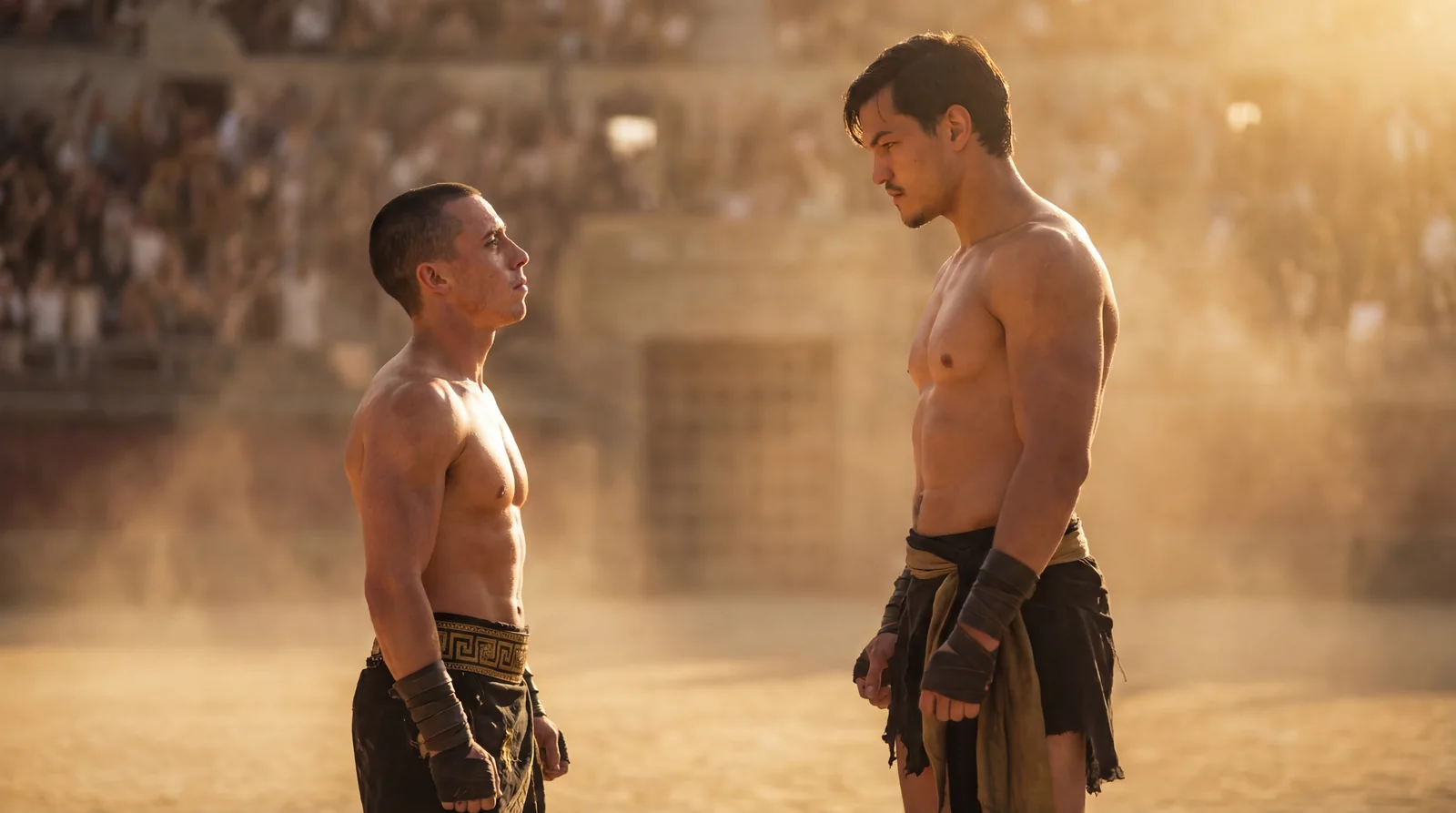
That was the central idea behind TALL ORDER: Nick Ball and Brandon Figueroa collide in a colosseum like gladiators, fighting for one world title. The proposition was simple. Making it believable was not.
AI commercial · 33 seconds Watch TALL ORDER
The film came through Vertical Haus for Queensberry Promotions and DAZN Boxing. It began with a drafted idea from the director, and my responsibility within the wider production was the hands-on AI visual build: character development, look development, image and motion generation, and the final picture edit.
Mike Staniforth’s account tells the detailed story of the wider five-day production and its journey to broadcast. Here is what I learned while creating the fighters, building their world, shaping the sequence and developing the workflow behind it.
Real fighters, real proportions
Most of the AI studies I was doing showed close-ups: one character speaking, perhaps another replying, often with people invented purely for the exercise. Those studies can show what a model does, but they avoid a harder problem. The people in TALL ORDER could not be random creations. They were Nick Ball and Brandon Figueroa, and boxing audiences already knew their faces, bodies and presence.
I began by making realistic character sheets for both fighters. I worked through facial structure, build, hair, profile, expression, wardrobe and lighting before taking any shot into motion. One impressive close-up was useless if the next shot no longer looked like the same person.
Their real height contrast was especially important. The difference is clearly visible, so it had to remain truthful—neither exaggerated for spectacle nor flattened to make generation easier. In full-body frames, face-offs and moving sequences, the two fighters had to occupy the image according to their real relative proportions.

That contrast naturally introduced a David-and-Goliath tension in scale, but not in role. The familiar myth tells us who the hero is and who stands in his way. I did not want the film to make that decision for the audience.
I was not building one hero against a villain. I was building two heroes.
Neither fighter could be reduced to “the giant” or “the underdog.” Both needed weight, dignity and their own sense of arrival. The image could create tension from their differences while leaving viewers free to decide whom they supported.


An open brief with a hard deadline
The wider production moved from concept to a 30-second international DAZN broadcast in under five days. As Mike Staniforth writes, the film needed “fight-night scale”, but “volume is not progress”: “approve the world, approve the shots, protect the edit.”
For that world, I drew inspiration from the cinematography of Gladiator: hard light cutting through dust, warm stone, deep shadow, backlit figures and monumental scale. I was not trying to reproduce a particular shot. I wanted the colosseum to give boxing’s existing rituals—the entrance, the stare-down, the crowd and the moment before impact—a mythic visual language.


Generating for the edit
At first, I did not know exactly how the idea would compress into its final broadcast length. I built contact sheets of possible moments: arena wides, entrances, faces, wardrobe details, confrontations and impact beats. Comparing them side by side helped me choose what belonged together and recognise what was missing.
Some images I thought I needed became repetitive in the edit. Others exposed a missing transition or suggested a stronger order. A large collection of attractive images was not yet a film; the sequence still needed geography, escalation, contrast, emotion and rhythm.
The music supplied to me became another guide. Its rises, pauses and impacts suggested when to reveal the arena, when to stay with a fighter and when to accelerate towards the collision. Because I was also cutting the final picture, generation and editing became a feedback loop: the images shaped the edit, and the edit told me what to generate next.

From social-first to live DAZN coverage
From my side of the production, TALL ORDER began as a social-first commercial. Then it aired during DAZN’s live international coverage of Ball vs. Figueroa.
I do not need to call it a global first to understand what that meant for me. It was the first time an end-to-end AI visual workflow I had led reached a live international sports broadcast. Seeing work built through character sheets, contact sheets, generation and picture editing hold its place inside a major fight-night presentation was one of the proudest moments of my early AI work.
The film continued to travel through Queensberry Promotions’ official Instagram account. As of 6 August 2026, the reel showed 6,131 likes, 101 comments and 99 reposts—a dated snapshot of the audience engagement around the work.
Watch the official campaign reel from Queensberry Promotions

What stayed with me
Before the arrival of Seedance 2.0, keeping characters, locations and proportions consistent was not easy. Kling 3.0 did a strong job, especially when I generated a sequence from a first frame or used start-and-end-frame techniques. It became a continuous edit in my head: every generation was already being judged by how it could enter, connect to and leave the next shot.
Kling alone did not solve every continuity problem. I also edited images in Photoshop to preserve character details, location elements and the relative proportions of the fighters before sending them back into the generation workflow. The process became a loop between FLORA, Kling 3.0, Photoshop and the edit.

The models will keep changing. The deeper lesson will remain.
AI did not remove the need for judgement. It made selection, continuity, scale, coverage and editing even more important. The workflow did not simply help me create what I wanted; it revealed what the film needed.
TALL ORDER was one of the most gratifying projects I had worked on. It taught me that speed is only useful when every image still serves the characters and the story.
Watch and read
«I pugili sono i nuovi gladiatori.»
Questa era l’idea centrale di TALL ORDER: Nick Ball e Brandon Figueroa si scontrano in un Colosseo come gladiatori, combattendo per un unico titolo mondiale. La premessa era semplice. Renderla credibile non lo era.
Spot AI · 33 secondi Guarda TALL ORDERIl film è arrivato attraverso Vertical Haus per Queensberry Promotions e DAZN Boxing. Tutto è cominciato da un’idea abbozzata dal regista e, all’interno della produzione più ampia, la mia responsabilità era il lavoro visivo concreto con l’AI: sviluppo dei personaggi, look development, generazione di immagini e movimento e montaggio video finale.
Il racconto di Mike Staniforth descrive nel dettaglio l’intera produzione di cinque giorni e il suo percorso fino alla messa in onda. Ecco cosa ho imparato creando i pugili, costruendo il loro mondo, dando forma alla sequenza e sviluppando il workflow che la sosteneva.
Pugili veri, proporzioni reali
La maggior parte degli studi sull’AI che stavo facendo mostrava primi piani: un personaggio che parlava, forse un altro che rispondeva, spesso con persone inventate esclusivamente per l’esercizio. Questi studi possono mostrare ciò che un modello è in grado di fare, ma evitano un problema più difficile. Le persone in TALL ORDER non potevano essere creazioni casuali. Erano Nick Ball e Brandon Figueroa, e il pubblico della boxe conosceva già i loro volti, i loro fisici e la loro presenza.
Ho iniziato creando character sheet realistici per entrambi i pugili. Ho lavorato su struttura del viso, corporatura, capelli, profilo, espressione, guardaroba e illuminazione prima di portare qualsiasi inquadratura in movimento. Un primo piano riuscito non serviva a nulla se nell’inquadratura successiva il soggetto non sembrava più la stessa persona.
Il loro reale contrasto d’altezza era particolarmente importante. La differenza è chiaramente visibile, quindi doveva rimanere fedele: né esasperata a fini spettacolari, né appiattita per facilitare la generazione. Nelle inquadrature a figura intera, nei faccia a faccia e nelle sequenze in movimento, i due pugili dovevano occupare l’immagine rispettando le loro reali proporzioni relative.
Quel contrasto introduceva naturalmente una tensione alla Davide e Golia nelle dimensioni, ma non nei ruoli. Il mito che tutti conosciamo ci dice chi è l’eroe e chi gli sbarra la strada. Non volevo che fosse il film a prendere questa decisione al posto del pubblico.
Non stavo costruendo un eroe contro un cattivo. Stavo costruendo due eroi.
Nessuno dei due pugili poteva essere ridotto al «gigante» o allo «sfavorito». Entrambi avevano bisogno di peso, dignità e di una presenza autonoma fin dal loro ingresso. L’immagine poteva creare tensione attraverso le loro differenze, lasciando però gli spettatori liberi di scegliere chi sostenere.
Un brief aperto con una scadenza serrata
L’intera produzione è passata dal concept a uno spot internazionale da 30 secondi trasmesso su DAZN in meno di cinque giorni. Come scrive Mike Staniforth, il film doveva avere «fight-night scale», ma «volume is not progress»: «approve the world, approve the shots, protect the edit».
Per costruire quel mondo, mi sono ispirato alla fotografia di Gladiator: luce dura che attraversa la polvere, pietra dai toni caldi, ombre profonde, figure in controluce e una scala monumentale. Non cercavo di riprodurre un’inquadratura precisa. Volevo che il Colosseo desse ai rituali già propri della boxe — l’ingresso, il faccia a faccia, la folla e il momento che precede l’impatto — un linguaggio visivo mitico.
Generare pensando al montaggio
All’inizio non sapevo esattamente come l’idea si sarebbe condensata nella durata finale prevista per la messa in onda. Ho costruito contact sheet di possibili momenti: campi larghi dell’arena, ingressi, volti, dettagli del guardaroba, confronti e beat d’impatto. Metterli a confronto uno accanto all’altro mi ha aiutato a scegliere cosa funzionava insieme e a riconoscere ciò che mancava.
Alcune immagini che pensavo mi servissero diventavano ripetitive nel montaggio. Altre rivelavano una transizione mancante o suggerivano un ordine più efficace. Una grande raccolta di belle immagini non era ancora un film: la sequenza aveva comunque bisogno di geografia, escalation, contrasto, emozione e ritmo.
La musica che mi era stata fornita è diventata un’altra guida. Le sue crescite, pause e battute d’impatto suggerivano quando rivelare l’arena, quando rimanere con un pugile e quando accelerare verso lo scontro. Poiché mi occupavo anche del montaggio video finale, generazione e montaggio sono entrati in un ciclo di feedback: le immagini plasmavano il montaggio e il montaggio mi indicava cosa generare dopo.
Dal social-first alla diretta DAZN
Dal mio punto di vista all’interno della produzione, TALL ORDER era nato come spot social-first. Poi è stato trasmesso durante la copertura internazionale in diretta su DAZN di Ball contro Figueroa.
Non ho bisogno di definirlo un primato mondiale per comprendere cosa abbia significato per me. È stata la prima volta che un workflow visivo AI end-to-end da me guidato è arrivato all’interno di una diretta sportiva internazionale. Vedere un lavoro costruito attraverso character sheet, contact sheet, generazione e montaggio video trovare il proprio posto in una grande presentazione di fight night è stato uno dei momenti di cui sono più orgoglioso nei miei primi lavori con l’AI.
Il film ha continuato a circolare attraverso l’account Instagram ufficiale di Queensberry Promotions. Al 6 agosto 2026, il reel mostrava 6.131 like, 101 commenti e 99 repost: un’istantanea datata del coinvolgimento del pubblico intorno al lavoro.
Guarda il reel ufficiale della campagna pubblicato da Queensberry Promotions
Quello che mi è rimasto
Prima dell’arrivo di Seedance 2.0, mantenere coerenti personaggi, ambientazioni e proporzioni non era facile. Kling 3.0 ha fatto un ottimo lavoro, soprattutto quando generavo una sequenza a partire da un first frame o utilizzavo tecniche start-and-end-frame. Era diventato un montaggio continuo nella mia testa: ogni generazione veniva già valutata in base a come avrebbe potuto entrare nel montaggio, raccordarsi e condurre all’inquadratura successiva.
Kling da solo non risolveva ogni problema di continuità. Modificavo inoltre le immagini in Photoshop per preservare i dettagli dei personaggi, gli elementi delle ambientazioni e le proporzioni relative dei pugili, prima di reinserirle nel workflow di generazione. Il processo è diventato un ciclo tra FLORA, Kling 3.0, Photoshop e il montaggio.
I modelli continueranno a cambiare. La lezione più profonda resterà.
L’AI non ha eliminato la necessità del giudizio. Ha reso selezione, continuità, scala, copertura delle scene e montaggio ancora più importanti. Il workflow non mi ha semplicemente aiutato a creare ciò che volevo: mi ha mostrato ciò di cui il film aveva bisogno.
TALL ORDER è stato uno dei progetti più gratificanti a cui abbia lavorato. Mi ha insegnato che la velocità è utile soltanto quando ogni immagine continua a essere al servizio dei personaggi e della storia.